
Python & Data Science
Data Analytics Course in Pune
Excel, SQL, Power BI and Tableau, practised on realistic business data until dashboards feel routine.
- Prepares for
- Job-ready skills
Python & Data Science
This data engineering course teaches you to build the pipelines that move data from where it is created to where it is used. You learn advanced SQL and PL/SQL, Python, MongoDB, Apache Spark and AWS data services, then put them together in ETL, streaming and warehouse projects. It suits graduates and developers who like back-end work.
 Build real data pipelines from your first weeks in the course
 Learn the SQL, Python, Spark and cloud skills data teams rely on
 Practise with trainers who explain why each pipeline step exists

18 modules, from fundamentals to job-ready practice.
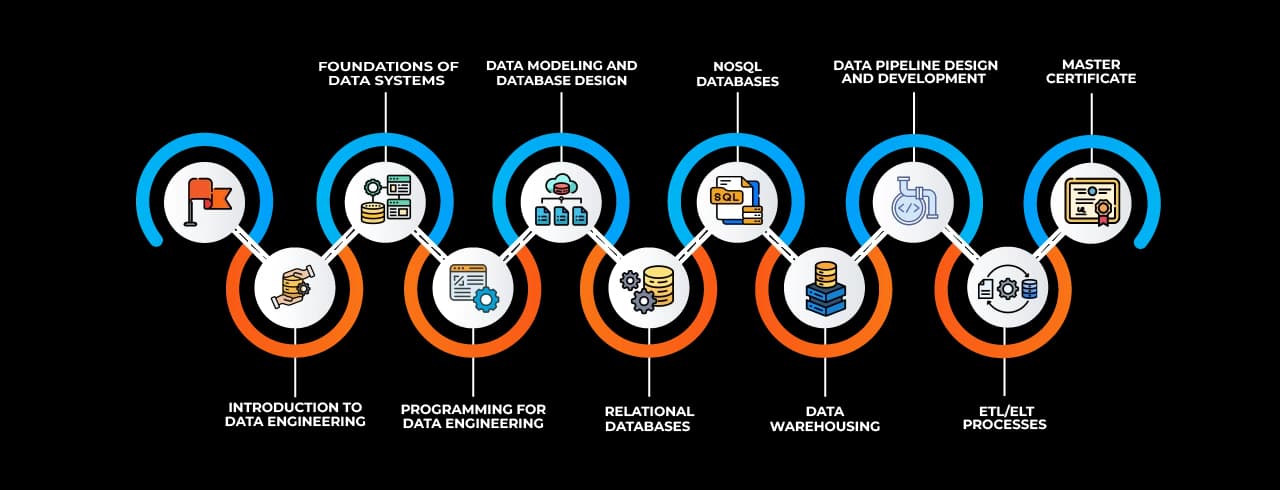
 SQL & Database Management(Relational & NoSQL Databases) – Design, manage, and optimize structured and unstructured databases for efficient data storage and retrieval.
 Data Warehousing(ETL, ELT, Data Lakes) – Build scalable data warehouses and lakes using ETL/ELT pipelines to consolidate and analyze large datasets.
 Big Data Processing (Hadoop, Spark)Process and analyze massive datasets efficiently with distributed computing frameworks like Hadoop and Apache Spark.
 Cloud Platforms (AWS)Leverage cloud-based services to store, process, and manage data at scale with AWS infrastructure.
 Data Modeling & Schema DesignDevelop optimized data models and schemas to ensure seamless data organization, integrity, and performance.
 Programming Languages(Python, Java, Scala) – Utilize programming languages for data manipulation, processing, and pipeline development.
 Data Pipeline Orchestration(Apache Airflow) – Automate, schedule, and monitor complex data workflows using Apache Airflow.
 Data Governance & Security(Data Privacy, Compliance) – Implement data security, privacy policies, and compliance measures to protect sensitive information.
 Tools & TechnologiesApache Spark (Batch & Stream Processing) – Perform high-speed batch and real-time data processing with Apache Spark.
 Kafka(Real-Time Data Streaming) – Enable real-time data ingestion, processing, and streaming with Apache Kafka.
 AWS Data Services(S3, Redshift, Glue, Kinesis) – Store, transform, and analyze large datasets using AWS cloud data services.
 ETL Tools(Informatica, Talend, dbt) – Automate and streamline data extraction, transformation, and loading processes for analytics.
 Containerization & Orchestration (Docker)Deploy and manage scalable, containerized data applications with Docker.

Build a pipeline that collects sales data from several sources, cleans it, checks it for consistency and stores it ready for reporting.

Capture a live feed of stock prices, process each update as it arrives and store the results for real-time charts and analysis.

Design a customer data warehouse that brings transactions together, so trend and business intelligence queries run quickly.

Ingest server log files and analyse them to find patterns, unusual spikes and possible security problems before they grow.

Extract e-commerce data, transform it and load it into a cloud data warehouse, so the business can report on it every day.
Every dashboard and every machine learning model depends on data that someone collected, cleaned and stored. That someone is the data engineer. You build the pipelines that pull data out of apps, databases and log files, fix what is broken in it, and load it somewhere the rest of the company can use it. If you enjoy back-end work and like things to run reliably, this is a good fit.
We follow the path data takes through a company, so each topic builds on the last:
Companies collect more data each year, and none of it is useful until it is organised. That makes data engineers a core part of data teams in finance, e-commerce, healthcare, logistics and IT services. The skills also connect to back-end development, cloud work and machine learning, so there are many directions you can grow in.
You can't learn pipelines from slides. Real data arrives late, in the wrong format or with missing values, and a good pipeline copes with all of that. So most of the course is project work, with a trainer reviewing your design and helping when a job fails.
Graduates in computer science, IT or engineering, developers who want to move into data, and analysts who want to build the pipelines they currently depend on. Basic programming helps, but the course starts with SQL and Python fundamentals.
Alongside the technical work, our career team helps with your resume, runs mock interviews on SQL, Python and pipeline design, and shares relevant openings. We're honest about it: no institute can guarantee a job, but clear, working projects make a strong case in interviews.
Choose classroom sessions or live online classes; both use the same syllabus and projects. Companies can also ask for batches planned around their own data stack. Fees and timings change per intake, so our counsellors share them on request.
It helps, but it isn't required. The course starts with SQL and Python basics before moving to Spark and cloud pipelines. Expect to practise a lot in the first few weeks.
A sales data pipeline, real-time stock price ingestion, a customer data warehouse, a server log processing system and a cloud ETL pipeline for e-commerce data.
Data Engineer, ETL Developer, Big Data Engineer, Cloud Data Engineer, Data Warehouse Engineer and Data Pipeline Engineer, among others.
Yes. Live online batches use the same syllabus, datasets and projects as the classroom. Ask us which timings are open for the next intake.
Yes. We help with your resume, run mock technical rounds on SQL, Python and pipeline design, and share relevant openings. No institute can guarantee a job, so we focus on projects you can explain well.
Excel, SQL, Power BI and Tableau, practised on realistic business data until dashboards feel routine.

Python, SQL, statistics and machine learning, learned by building data projects from start to finish.
From first script to automation and data analysis, ending with a capstone you can show.
Page last reviewed on .