What is software testing, and why is it a strong career choice?
Software testing checks that an application works correctly and does what its requirements say. As more finance, healthcare and retail services move online, they depend on software that is stable and secure. Testing uncovers functional bugs, security weaknesses, performance problems and usability issues before users ever see them. In this course you learn to take an application from untested code to a reliable product that is ready for release.
Testing is one of the most stable long-term careers in IT. As software keeps growing, quality assurance (QA) professionals stay in demand regardless of which languages or frameworks a team uses. The work suits people who enjoy analytical thinking combined with hands-on technical execution.
- Steady demand: growing companies need QA teams at every stage of development, and freshers can enter testing without a deep coding background, learning the scripting they need along the way.
- Room to grow: pay rises as you move from manual testing into automation and advanced tools, and with the depth of your experience.
- Lasting skills: from mobile apps to large cloud platforms, everything that gets built needs testing.
Why learn software testing with us?
Two things matter most in a testing course: hands-on practice and mentors who know the industry. Our sessions are practical rather than lecture-based and are modelled on how a QA team works inside a company, so by the end you can handle a technical testing interview with confidence.
We connect classroom learning with what employers expect, in a collaborative, feedback-driven setting. Experienced trainers review your test case documents, scripts, test reports and defect traceability at every stage.
You leave the textbook behind early: writing test plans, running complex test cases and managing live defect logs in a working environment.
- Complete tool coverage: the manual techniques QA teams use every day, including UI and back-end database testing, plus the main automation tools.
- Flexible batches: weekday and weekend batches, and an online course you can attend from anywhere.
- Placement support: help from resume writing and mock technical tests to soft skills and placement drives.
Which tools and technologies will you learn?
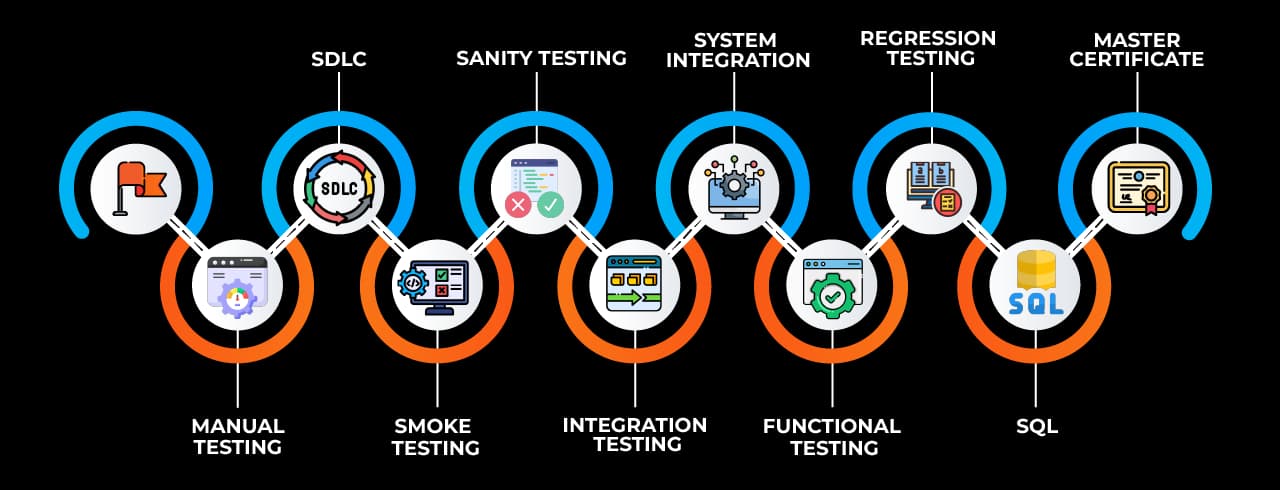
The course teaches quality assurance with the tools and methods testing teams use worldwide. It begins with manual testing fundamentals, including the SDLC and STLC, and then moves into automation, so you build strong reasoning in the manual phase before writing test scripts in code.
Starting with manual testing in depth and then moving to automation develops the critical thinking good testers rely on. By the end of the course you are also prepared to sit the ISTQB certification exam, which is recognised in India and abroad.
- Selenium WebDriver with Java: write automated browser tests and learn the object-oriented Java you need to organise and run them well.
- TestNG: manage test suites, write assertions, generate reports and run tests in parallel for faster results.
- JIRA and Bugzilla: log, track and manage defects in the tools large companies use.
- Postman: test APIs beyond the user interface, checking data exchange, response codes and endpoint security.
- SQL and JMeter: test databases with targeted queries and load-test servers under increasing traffic.
How do live testing projects build your skills?
Reading about bug life cycles and test scripts is one thing; working through real failures and documenting them is another. Our assignments run in live application environments, so you see how QA fits into real release cycles for web, mobile and enterprise software.
This practice builds the critical thinking, deductive reasoning and structure a tester needs. You take on a QA role testing multi-tier builds and see how testing ties into the release cycle when code changes ripple through dependent modules.
- Requirement analysis: turn a project brief into a thorough manual testing matrix.
- Test case design: write well-reasoned test cases that add up to a complete manual test plan.
- Defect reporting: find a defect, reproduce it and document it in a professional format.
- Edge cases: test boundary values, unusual usage and intermittent failures that affect the core of an application.
What placement and career support do you get?
Our aim is to get you job-ready, so you can start working while you keep learning on real projects. We help you prepare for roles in IT companies and product firms and share suitable openings, though no institute can promise a job.
Career preparation starts early in the course. We help you build a portfolio as strong as your project work, so it stands out to hiring managers for automation, framework scripting, API testing and defect management roles.
- Resume building: a resume that highlights your automation, scripting, API testing and defect management skills.
- Mock interviews: practice HR rounds, logic tests, manual design challenges and live coding.
- Workplace skills: how to present a bug to developers, work with a development team and justify your test coverage in a Scrum meeting.
- Placement drives: recruitment drives where you can apply for testing roles.
Which learning mode suits your schedule?
Everyone has different commitments at work or college, so we offer several training formats. Classroom and online batches use the same material, the same live projects and the same individual feedback from mentors.
The result is a balance between depth and flexibility, so working professionals can switch domains or upskill without taking a break from their careers.
- Classroom batches: face-to-face training at our Pune centre, with practical testing labs.
- Online classes: live sessions with screen sharing and chat support from instructors while you practise.
- Weekend batches: Selenium automation classes on Saturdays and Sundays for students and working professionals.
- Corporate training: customised programmes for company teams, covering agile testing, API validation, load testing and building test frameworks.
How we support you through the course
We act on student feedback and have focused on the things that often go wrong in training: accountability, a structured schedule, clear career guidance, consistent batches, steady pacing with regular doubt clearing and support after you enrol.
The course is built around accountability, a clear completion timeline and a sincere effort to prepare you for the right job.
- Consistent batches: your batch follows the planned syllabus in the mode you chose. Ask the counsellor about our policies before you enrol.
- Honest placement support: we don't promise 100% placement, because no one can. Instead, we track your interview preparation and help you get interview opportunities.
- Steady pacing and doubt-clearing labs: Selenium and Java scripting are taught at a pace that gives you time to absorb them, with weekly labs for open questions.
- Support after you enrol: help continues as you work through the course and into your job search.
How does software testing connect with other technologies?
Modern software is built from connected systems, so a versatile QA professional needs to test across them: enterprise applications, data pipelines, cloud infrastructure and AI-powered features.
Understanding the stacks you test takes you from running scripts to analysing whole systems, which makes you valuable to any modern engineering team.
- Data science and analytics: test data-driven applications against user behaviour, performance and the logic of their algorithms.
- Python and Java: test back ends and write automated tests for enterprise applications in the languages they are built with.
- Cloud and DevOps: run automated test suites inside CI/CD pipelines that deploy to the cloud.
- Cyber security: write test cases that probe applications for vulnerabilities.
- AI applications: test chatbots, generated content and machine learning features.
- Power BI and Salesforce: validate dashboards and CRM workflows across platforms.
- SAP: test end-to-end business processes in large enterprise systems.
Common questions
1. What does a software testing course teach?
It teaches you to find defects, test manually and with automation, write test cases and use industry testing tools, so that software is released stable, working and up to the quality standards set during the SDLC and STLC.
2. Who can join?
Any graduate or diploma holder with an interest in quality assurance: freshers, IT professionals upgrading their skills and career switchers moving into testing.
3. What skills will I learn?
Manual and automation testing, test case design, bug reporting, the SDLC and STLC, agile testing and API testing, with tools such as Selenium and Jira.
4. Is software testing a good career?
Yes. Almost every industry that builds software needs testers, and demand grows as more applications are developed.
5. Is the training practical?
Yes. You learn through real projects, testing scenarios and assignments.

 Build your software testing skills with focused, practical coaching
 Learn manual testing, automation tools and quality assurance practice
 Prepare for a QA role and recognised testing certifications